Crackdown on Dangerous Rented Homes as New £7,000 Fines Take Effect
For years, much of the focus on landlord compliance has centred around paperwork: gas safety certificates, electrical inspections, deposit protection and prescribed information. While these obligations remain essential, the spotlight is increasingly turning towards something even more important, the condition of the property itself.
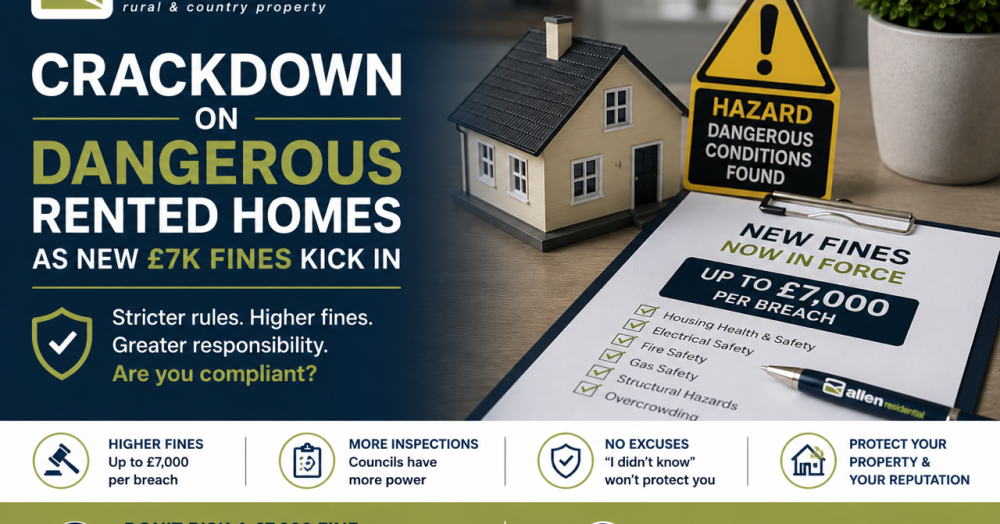
Recent changes to housing enforcement powers mean local authorities now have stronger tools available to tackle serious hazards in privately rented homes.
For landlords, this is a timely reminder that compliance is about more than certificates and documents; it is also about ensuring homes remain safe and suitable for occupation.
What Has Changed?
The government has strengthened enforcement measures available to local authorities where serious housing hazards are identified in privately rented properties.
These hazards can include:
- Damp and mould
- Excess cold
- Electrical safety defects
- Fire risks
- Structural concerns
- Trip and fall hazards
Councils already have powers to require improvements and take enforcement action where necessary. However, recent reforms have increased the range of penalties available and placed greater emphasis on proactive enforcement within the private rented sector.
Under the updated framework, local authorities may impose financial penalties of up to £7,000 in certain circumstances where serious housing hazards are identified and enforcement action is considered appropriate.
For the most serious housing-related offences, financial penalties can be significantly higher.
Why This Matters to Landlords
Many landlords operate professionally and maintain their properties to a high standard. However, the regulatory landscape continues to evolve, and expectations around property standards are increasing.
Importantly, landlords should not rely solely on tenants reporting problems when they arise.
Regular inspections, prompt responses to maintenance concerns and accurate record keeping can help identify issues before they escalate into more serious and costly problems.
Increasingly, councils are using information from tenant complaints, inspections and other intelligence sources to identify properties requiring further investigation.
Compliance Is More Than Certificates
A valid Gas Safety Record, EICR and EPC remain fundamental legal requirements.
However, holding the correct certificates does not automatically mean a property is free from hazards under housing health and safety legislation.
A property may still present risks relating to damp, excess cold, fire safety or structural defects despite having all required documentation in place.
Landlords should therefore view certification as one part of a wider compliance strategy rather than the end goal.
A Balanced Approach to Damp and Mould
Damp and mould continue to receive significant attention from both local authorities and government.
However, not all cases arise from landlord disrepair.
When assessing housing hazards, councils will generally consider the underlying cause of any issue. Factors such as building defects, insulation, heating provision, ventilation systems and, where relevant, occupant behaviour may all be taken into account.
This highlights the importance of maintaining clear records, responding promptly to reports and documenting any investigations or remedial works carried out.
Questions Every Landlord Should Ask
As enforcement activity increases, landlords may wish to consider the following:
- When was the property last inspected?
- Have all reported maintenance issues been investigated?
- Are ventilation systems operating correctly?
- Are there any signs of damp, mould or condensation that require further assessment?
- Are electrical installations and fire safety measures being properly maintained?
- Is there a clear record of inspections, maintenance and communications?
If any of these questions create uncertainty, now may be the right time to review the property’s compliance position.
Prevention Is Always Cheaper Than Enforcement
The vast majority of landlords want to provide safe, well-maintained homes for their tenants.
The challenge is that small issues can sometimes develop into larger problems if they are not identified and addressed early.
By taking a proactive approach to inspections, maintenance and compliance, landlords are likely to be in a stronger position should their property ever come under scrutiny from a local authority.
As the private rented sector continues to evolve, the most successful landlords will be those who treat compliance as an ongoing process rather than a one-off exercise.
If you would like an independent review of your property’s compliance position or guidance on current landlord obligations, our team would be happy to help.
Please feel free to contact us on (01761) 412 300 for the Paulton office, (01749) 672 678 for the Wells office and email lettings@allen-residential.co.uk