Landlords Facing Unsustainable Delays: What This Means for the Local Rental Market
Recent industry reports highlight a growing issue across England and Wales: landlords are now waiting record lengths of time to regain possession of their properties through the courts. For many, the process is stretching well beyond six months — and in some areas considerably longer.
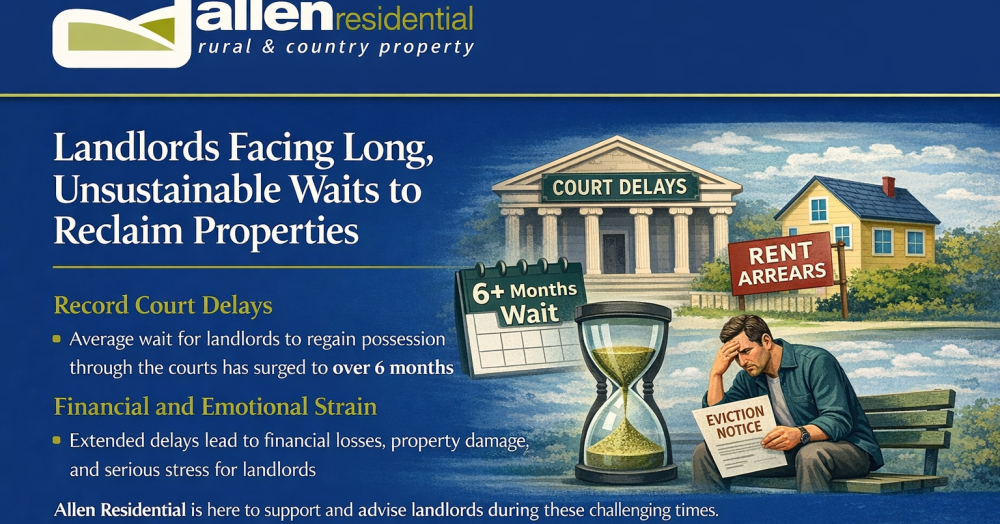
At Allen Residential, we are seeing first-hand how these delays are affecting responsible landlords who simply need clarity, certainty and control over their investments.
The Reality Behind the Headlines
When a tenancy breaks down — whether due to persistent rent arrears or breaches of agreement — landlords must follow the correct legal route. That route increasingly involves:
Lengthy notice periods
Delays in securing court hearings
Further waiting times for possession orders
Additional delays arranging bailiff enforcement
What was once a structured and reasonably predictable process has become prolonged and, in many cases, financially draining.
The Financial Impact
Extended possession timelines create significant pressure, particularly where:
Rent arrears continue to accumulate
Mortgage payments remain due
Insurance conditions require active management
Maintenance responsibilities continue
For many landlords, rental income is not “bonus” income — it is tied directly to mortgage commitments, pension planning, or long-term financial security.
When possession takes 30+ weeks, the financial exposure can quickly escalate.
An effective Rent Guarantee Policy is essential in stemming the tide financially
The Emotional Toll
Beyond the numbers, there is a human element.
Landlords often feel:
Frustrated by lack of progress
Powerless within a slow system
Concerned about property condition
Uncertain about future regulatory changes
The combination of financial strain and legal complexity can understandably lead some to reconsider their position in the market.
What This Means for Supply
As more landlords reassess risk, we are already seeing reduced rental stock in many areas. Fewer available properties ultimately means:
Increased rents due to demand pressure
Greater competition for tenants
More strain across the wider housing sector
A balanced rental market depends on confidence from both landlords and tenants. Prolonged court delays undermine that balance.
The facts in simple numbers :-
New Ministry of Justice figures reveal a widening gap between falling possession claim volumes and rising court delays.
At a time when most landlords still rely on Section 21 to regain their properties, official data shows that 91,093 landlord possession claims were issued in 2025, down from 98,766 in 2024, a fall of 7.8% year on year. The decline was seen across both main possession routes, with accelerated claims falling 12.8% and Section 8 claims down 4.9%.
However, while claim volumes have eased, timelines have lengthened. The median time from claim to repossession rose to 27 weeks in 2025, up from 25 weeks the previous year. Excluding the pandemic backlog, that is the longest median wait in more than two decades.
For landlords dealing with significant arrears, extended timelines can translate into substantial financial losses. Separate research published by the High Court Enforcement Officers Association in October 2025 found that the average rent loss per property at the point of eviction stands at £12,708 nationally, rising to £19,223 in London.
Information provided by Landlord Zone https://www.landlordzone.co.uk/news/latest-landlords-face-unsustainable-waits-to-regain-properties
Last year, 43% of all new instructions received by Landlord Action related to Section 21 or accelerated possession claims, while 27% related to Section 8 notices. With Section 21 due to be abolished in May, all future possession cases will need to proceed under statutory grounds through the court system. The firm says this will place greater reliance on a court process that is already experiencing record timelines.
The impact of longer delays is being seen daily in cases handled by the firm. A recent Section 8 PCOL claim submitted on 19th November 2025 has been listed for hearing on 26th February 2026. Historically, similar cases would typically have been listed within two months.
The greatest pressure is now at the enforcement stage. In London cases handled by Landlord Action, eviction appointments are being listed seven or eight months after bailiff applications are submitted. In one instance, an application made on 26th November 2025 was given an enforcement date of 17th July 2026.
Securing
These delays mean that even after securing a possession order, landlords may face many additional months before enforcement takes place. In serious arrears cases, the total process from notice to eviction can approach a year.
Ministry of Justice data reflects similar strain nationally. While warrants of possession issued fell to 39,101 in 2025, the number of landlord repossessions carried out by County Court bailiffs increased to 28,628, suggesting that cases already in the system are continuing to move through enforcement even as new claims decline. Regional figures show that London local authorities account for six of the ten highest private landlord repossession rates nationally in the final quarter of 2025.
The growing pressure on County Court bailiffs has prompted renewed calls for greater use of High Court enforcement in appropriate cases. The report published by the High Court Enforcement Officers Association, supported by Landlord Action, found landlords were experiencing average County Court bailiff delays of six months nationally and up to eight months in London once a possession order had been granted.
Years
Landlord Action founder Paul Shamplina explains that years of underinvestment in the courts are now translating into record waiting times. “At the same time, the majority of landlords we act for are still relying on Section 21,” he says. “Once that route is removed, every case will depend on a court process that is already under pressure.”
With the mandatory rent arrears threshold increasing from two months to three months and notice periods extending to four weeks under the new rules, landlords will face longer timelines before they can secure a possession order. Once an order is granted, enforcement delays can add further months, he adds.
“When you combine extended notice periods, longer court waiting times and enforcement delays, it is not unrealistic for a landlord to face close to a year of unpaid rent in serious arrears cases. For many smaller landlords, that level of exposure is simply unsustainable.
Prepare
“Landlords will need to prepare for a system that is slower and more reliant on the courts," says Shamplina. "Careful tenant selection, stronger referencing, ensuring tenants have a suitable guarantor where appropriate, and considering rent guarantee insurance as a core protection rather than an optional extra.”
The Law Society of England and Wales has urged the UK government to further invest in the courts to handle the expected rise in contested hearings and avoid additional delays and backlogs in the courts. President Mark Evans says: “Next year’s data will ultimately show how the Renters’ Rights Act contributes to a fairer housing system, including how the abolition of Section 21 in England affects the overall repossession statistics. The courts must start getting ready now, not after the backlog starts growing even more.”
How Landlords Can Protect Themselves
While systemic reform sits outside individual control, there are proactive steps landlords can take:
✔ Thorough referencing and affordability checks
✔ Professional tenancy agreements
✔ Proactive arrears management
✔ Legal expense and rent protection insurance
✔ Experienced property management oversight
At Allen Residential, our focus is prevention first. Clear communication, structured processes and early intervention often prevent issues from escalating to court stage.
If however, there becomes the case whereby a tenant is in arrears then an effective rent guarantee policy is an absolute must to stem the tide financially
Looking Ahead
There are increasing calls for court reform and improved efficiency within the possession process. A system that protects tenants’ rights must also function effectively for landlords who operate responsibly and within the law.
Until meaningful improvements are delivered, strategic management and careful planning remain essential.
If you are concerned about the current landscape or would like to review your portfolio strategy, our team is always available for confidential guidance.
You can book a call with James Allen HERE to discuss the benefits of having a rent guarantee policy in place
Allen Residential
Professional. Proactive. Protective of your investment.
