Landlords: You Survived 1 May. But Is Your Property Still Compliant?
The Renters’ Rights Act has changed the rules. Now landlords need to make sure their properties, paperwork and processes have changed with them.
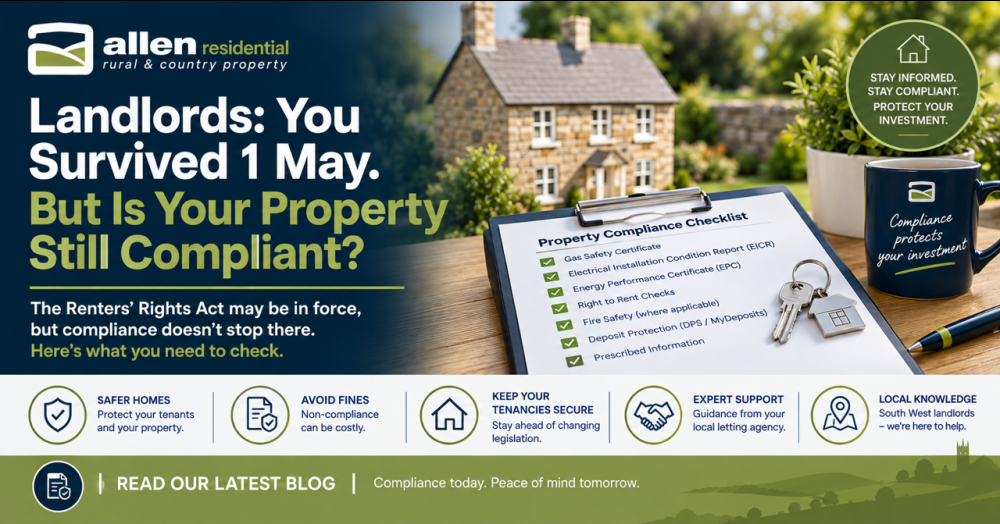
For many landlords, 1 May 2026 was the date circled in the diary.
The Renters’ Rights Act came into force. Section 21 ended. Fixed-term assured shorthold tenancies were replaced by assured periodic tenancies in most cases. New rules around rent increases, pets, tenant information and possession came into effect.
But now we are several months into the new regime, there is an important question landlords should be asking:
“Is my property actually compliant today?”
Because compliance is not a one-day exercise.
And with the next stage of rental reform now approaching, simply having dealt with the changes in May may not be enough.
The biggest landlord mistake right now?
Assuming that because something was compliant in May, it remains compliant today.
A rental property is a moving asset.
Tenants change. Circumstances change. Certificates expire. Repairs arise. Legislation develops. Documents get replaced. Rent changes. Occupiers can change.
And increasingly, landlords are expected to be able to demonstrate that they have stayed on top of those changes.
The government’s next phase of the Renters’ Rights Act is already moving forward. The new Register Your Rental Property service will begin rolling out regionally from 15 December 2026, starting in the West Midlands, with the rollout continuing across England over the following 12 months. (GOV.UK)
The government has also confirmed that landlords will ultimately be required to provide information about themselves, their properties and key safety information.
That means the quality of the information held about your property is becoming increasingly important.
So, what should landlords be checking now?
Rather than waiting for the next legislative deadline, September is a good time for a property compliance health check.
1. Are your tenancy documents up to date?
The old assured shorthold tenancy model is no longer the basis for most new private rented tenancies in England.
The government’s guidance confirms that the Renters’ Rights Act introduced assured periodic tenancies and removed Section 21 possession proceedings for new cases from 1 May 2026. (GOV.UK)
For landlords with existing tenants, this is particularly important.
Your tenancy file should accurately reflect:
● who the legal tenants are
● who is permitted to occupy the property
● the current rent
● the correct tenancy structure
● any agreed changes to the tenancy
● relevant notices and correspondence
● evidence that required information has been provided
A tenancy agreement sitting in a folder is not necessarily the same thing as having a properly maintained tenancy file.
2. Are your safety certificates still valid?
This is one of the easiest areas for a landlord to overlook.
Gas safety checks must continue to be carried out annually where gas appliances, flues or fittings supplied by the landlord are present. The government confirms that tenants must receive the relevant gas safety record. (GOV.UK)
Electrical safety is another area that should not simply be treated as a document obtained when the property was first let.
Government guidance requires electrical installations in privately rented properties to be inspected and tested at least every five years by a properly qualified person, with the appropriate report and remedial action where required. (GOV.UK)
The question for landlords should therefore be:
“If someone asked me for every current compliance document for this property today, could I produce it?”
If the answer is no, that is worth addressing.
3. Have you dealt with repairs properly or simply dealt with them quickly?
There is an important distinction.
A landlord may have arranged for a leaking tap, faulty boiler or broken extractor fan to be repaired.
But good property management is about more than getting a contractor through the door.
You should also be able to demonstrate:
● what was reported
● when it was reported
● how it was assessed
● what action was taken
● who carried out the work
● whether further work was recommended
● when the issue was resolved
That paper trail can become extremely valuable if a dispute arises later.
Good records are not bureaucracy for bureaucracy’s sake. They are evidence.
4. Do you know who is actually living in your property?
This is becoming increasingly important.
People’s circumstances change.
A partner moves in. A child reaches adulthood. A permitted occupier becomes a regular resident. Someone leaves. Someone else takes their place.
Landlords should know exactly who is occupying their property and under what basis.
That does not mean refusing reasonable requests from tenants.
It means making sure changes in occupation are properly understood, documented and dealt with in accordance with the tenancy and the law.
5. Are you still increasing rent in the way you used to?
This is another area where landlords need to be particularly careful.
The Renters’ Rights Act introduced new rules around rent increases, including the use of the revised Section 13 process.
The government’s guidance should be checked before any rent increase is served, rather than relying on a process used under the old tenancy regime. (GOV.UK)
A rent increase may appear straightforward. The process behind it is where mistakes can occur.
6. What happens if your tenant complains?
This is perhaps the most important question of all.
A professional landlord should not only ask:
“Am I compliant?”
They should ask:
“Can I prove that I am compliant?”
If a tenant raises a complaint, the strength of a landlord’s position may depend heavily on the quality of their records.
That means retaining appropriate evidence of:
● inspections
● certificates
● repairs
● communications
● rent changes
● tenancy changes
● notices
● contractor attendance
● tenant requests
● actions taken
The forthcoming PRS Landlord Ombudsman is another reason for landlords to start thinking more carefully about how complaints and property records are handled.
The government expects the Ombudsman to become mandatory for private landlords, although implementation is expected after the database rollout and currently points towards 2028. (GOV.UK)
The next phase of landlord regulation is already coming
The government has confirmed that the new registration service will begin its rollout on 15 December 2026.
Landlords will be given a three-month period when their area is called forward, and the government says all actively let landlords should have registered by 14 November 2027. (GOV.UK)
Importantly, this is not simply an online form.
The government expects the database to contain information about landlords and properties, including safety information such as gas, electrical and energy performance certificates. (GOV.UK)
And failure to register can have financial consequences.
Government guidance states that a landlord who lets or advertises a property without first registering may face a civil penalty of up to £7,000, with substantially higher penalties possible for repeated or serious breaches. (GOV.UK)
This is why getting the underlying property information right matters.
A property compliance health check could be the smartest thing you do this autumn
For landlords across the South West, now is an ideal time to step back and look at the property as a whole.
Not just:
“Do I have a tenant?”
Not just:
“Is the rent being paid?”
But:
“If my property were audited tomorrow, could I demonstrate that I have done everything expected of me?”
A sensible review should consider:
Tenancy
● Is the tenancy correctly documented?
● Are all occupants and tenants correctly recorded?
● Are any historic tenancy changes documented?
Compliance
● Gas safety
● Electrical safety
● EPC
● Smoke and carbon monoxide alarms
● Property-specific licensing requirements
Property condition
● Outstanding repairs
● Recurring maintenance issues
● Damp, mould or ventilation concerns
● Recommended works
● Evidence of action taken
Financial
● Current rent
● Rent review history
● Deposit information
● Permitted tenant charges
● Arrears or payment issues
Records
● Tenant correspondence
● Contractor records
● Inspection reports
● Certificates
● Notices
● Evidence of information provided to tenants
The landlords who will be best positioned for the next phase won’t necessarily be the biggest landlords.
They will be the landlords who know their properties.
The Renters’ Rights Act is changing the relationship between landlords and tenants.
The government’s new registration system will increase the information held about privately rented properties.
And the future Landlord Ombudsman will introduce another layer of accountability and redress.
For a landlord with one property, that can feel like an enormous amount to keep track of.
For a landlord with five, ten or twenty properties, it can quickly become a full-time job.
This is where professional management becomes about much more than collecting rent.
At Allen Residential, we believe good letting management is about knowing what is happening with a property before it becomes a problem.
It is about keeping records, monitoring compliance, understanding changing legislation, managing repairs, reviewing tenancies and giving landlords confidence that their property is being actively managed rather than simply rented out.
September is a good time for a property health check.
Don’t wait for the next deadline, the next inspection or the next problem to find out whether your property is genuinely ready.
If you are a landlord in the South West and would like an independent review of your property’s current position, speak to Allen Residential.
Your property may be compliant.
But the more important question is:
Can you prove it?
